| Re-Playability | 5/5 |
| Plot Design | 5/5 |
| World Design | 5/5 |
| Character Design | 5/5 |
| Graphic Design | 5/5 |
| Audio Design | 5/5 |
| Accessibility | 5/5 |
| Platform Compatibility | 5/5 |
| Developer Support | 5/5 |
| Community Vibe | 5/5 |
| Innovation in Genre | 5/5 |
| Application Security | 4/5 |
| Server Stability | 3/5 |
| Client Stability | 5/5 |
Introduction
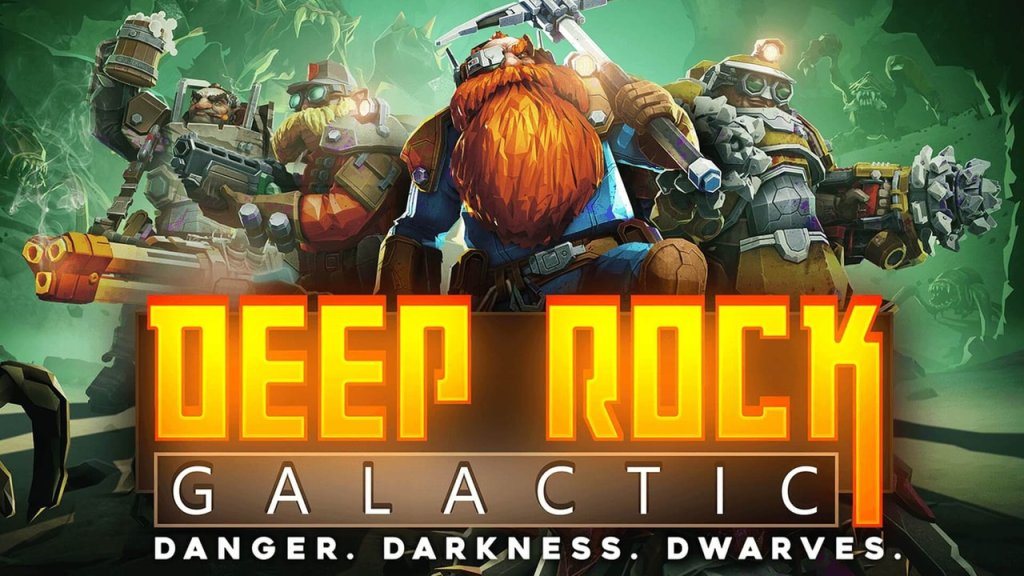
First released into Early Access on Steam in 2018, Deep Rock Galactic (DRG) has become a shining example of how Horde Shooters can absolutely nail every aspect of their game play. Developed by Ghost Ship Games and published by Coffee Stain Publishing, DRG immediately captured the hearts of millions going on to sell well over 4 million copies and forever establishing Ghost Ship Games as a competent game development studio. Featuring 1-4 player co-op, players take on the roles of Dwarves working for the Interstellar Mining Corporation, Deep Rock Galactic. Based out of Mining Station 17 orbiting the planet Hoxxes IV, players dive down into the planet and face off against hordes of mutated creatures as they mine resources and precious minerals and complete primary and secondary objectives.
Core game play focuses on playing a handful of mission types as well as completing weekly Deep Dives and Elite Deep Dives. Players may choose missions located in several diverse biomes of Hoxxes IV, each sporting its own environmental design, hazards, and preferred creatures. Cave structure is procedurally generated and each mission has both a Cave Complexity and Cave Length parameter determining the overall physical structure of the mission. Additionally, players may encounter unique events or creatures that are rolled for (meaning they appear according to random chance) on each mission that may unique bonuses during missions or provide opportunities for player progression.
DRG is loaded with customization options. Players may choose to customize the entire appearance of their Dwarf including the individual clothing elements they wear, all of their facial hair, and what color their skin and hair are. Additionally, players may customize the appearance and color of all of their weapons, including their pickaxe. However, players may not customize the appearance of their traversal tool. All of these customizations are unique for each class of Dwarf: Gunner, Scout, Engineer, and Driller.
The game also features a fleshed out character progression system. Players earn experience from completing primary and secondary objectives during missions as well as mining gold. Each biome also features two different types of precious minerals that can be found during missions. These precious minerals are used for buying certain clothing items, purchasing weapon mods, crafting weapon and cosmetic overclocks, and for promoting Dwarfs once they reach the level cap for their current rank.
There is also a thriving community outside of the game with digital presence on Discord, in official forums, on Reddit, and on the Steam Forums. There’s even Discord integration in-game in the form of Miners Unions. The purpose of the Miners Union is to reward player for community effort. These efforts range across a variety of objectives usually themed for the specific union including goals such as mining so much of a specific resource, finding so many compacted minerals, killing so many specific enemies, etc.. Completion of these objectives are tiered with players being rewarded for every tier they complete.
DRG has a bit of everything to appease to a wide audience. I firmly believe it is one of the best games ever created and rank it in my overall top five video games of all time.
World Building Overview
As mentioned prior, Deep Rock Galactic centers on the efforts of Dwarven miners that work for the eponymous interstellar mining corporation. Orbiting the blue star Creus, Hoxxes IV is a tidally locked planet rich in precious minerals. Proximity to Creus has seen the planet constantly bombarded in radiation that has radically altered the wildlife, flora, and biomes of Hoxxes IV. Only the bravest (or dumbest) souls would step foot on this planet, and to attract these unfortunates, Deep Rock Galactic pays exceptionally well. Not only is the planet home to the most dangerous ecosystems in the solar system, it is also plagued by near apocalyptic natural events that to any ordinary person, would send a clear “do not enter” signal.
Players can choose between four different classes, each with their own unique play style and personality. Gunner brings heavy armaments such as Miniguns, Rocket Launchers, and Autocannons to the fight allowing him to easily fend off wave after wave of Hoxxes hostile denizens. Also, when the situation heads south, he is able to deploy a bubble shield that he and his teammates can take cover in. Scout offers the best maneuverability as well highest single target damage in the game. Additionally, he brings to the table the best source of light in the caves in the form of the Flare Gun. Engineer is the quintessential support character with employable turrets, platforms, and a whole suite of devastating secondary weapons. Lastly, Driller offers additional crowd clearance from Flamethrowers, Cryo Cannons, and the Sludge Pump. He is equipped with modular drill arms and can easily dig through the terrain of Hoxxes. And when that isn’t enough, he is also able to deploy C4 plastic explosive to clear both enemies and terrain alike.
Facing against this collection of fools are the various wildlife of Hoxxes. The most numerous group of enemies encountered in game are the Glyphids. Tunnelers by nature, these Dwarf sized arachnoids come in various forms allowing them to slow players, spit acid on them, drench them in septic spray, explode on them, or even blow massive holes in the environment, taking any unfortunate Dwarves with them. The core bosses for Deep Rock Galactic also come from the Glyphid Armata.
Next are the Mactera. A family of flying menaces. Mactera can often be found hovering in pods in wide-open caves. Once triggered, the entire pod will pursue any and all Dwarves they can find. With most members of this species only capable of ranged attacks, they are able to lob caustic bile at players from notable distances while others will shower Dwarves with sticky goo that impedes their movement. The most dangerous Mactera is the Grabber. As the name suggests, it creeps up on unsuspecting Dwarves clutching onto them and carrying them off to heights unfathomable only to drop them to an embarrassing death.
There are of course other various creatures found in the caves. Some of these are biome specific such as the Nayaka Trawler and the Deeptora Honeycomb, while others such as the silent and deadly Cave Leech can be encountered in any biome. The point of all this is to say that Deep Rock Galactic features a creature rich set of biomes where each mission is a constant fight for your life. Enemies are intelligent, have unique behaviors, and will attempt to swarm and surround players at all times. Furthermore, enemy design is masterfully done. It is simple to differentiate the enemy types within species from each other, as well as differentiating between species. This allows for rapid triaging of threats and prioritization of returning fire.
As I mentioned in the Introduction, Dwarves are fully customizable. Players unlock more customization options as they progress through the game, and none of the outfits or skins are locked behind paywalls, save for the completely optional DLC. The only complaint about Deep Rock Galactic that regularly is echoed across all forums is the lack of female Dwarves. According to Ghost Ship Games, the technical reason for this is because animations are tied to the existing model rigs for the current set of Dwarves. Adding female Dwarves to the game would require re-implementing the over 3,000 animations for the new models, which in my opinion is a tremendous effort to ask of such a small team to do all at once. I believe they’ll get there, but it will likely take a good deal of time and effort.
One last detail before I conclude this section. All of the biomes, weapons, creatures, and Dwarves are completely detailed in the in-game compendium. This is actually where most of the lore for DRG can be found. This compendium fills out as the player embarks on missions. Discovered creatures have their weaknesses highlighted by the compendium as well as the strength and range of all of their attacks, including any special abilities they may have. Lots of games tend to hide this information, so it is nice to see DRG put this at the forefront for players to work with.
Technical Overview
Deep Rock Galactic in its current state is technically sound. I very rarely crash in single-player, and when faults occur in multiplayer, its almost always because of the nature of multiplayer being Peer-to-Peer, not the game itself. The in-game systems are clean and intuitive. The user interface is simple and stays out of the players way with only minimal elements indicating players on the team and their corresponding health and shields, as well as the currently equipped weapon and magazine ammo versus total ammo, and a compass. Players make use of a topographical scanner in game to orient themselves in the cave system and to find interactable objects. There used to be problems with Molly, the automated mineral storage unit that follows Dwarves around, in earlier versions of the game. Notably, she would occasionally not be able to find a route back to the drop pod, but those days are long past. I personally have never seen this since I started playing the game when it first launched out of Early Access.
Audio design is on-par with other games in the Horde Shooter genre. Enemies emit omni-directional sound indicating where they are coming from and all attacks are completely telegraphed ahead of time by both audio and visual cues. Music fits the vibe for the cave system, most of the time it’s eerie and mysterious, then when a Swarm occurs, an appropriate Swarm track is faded into, reaching full crescendo once the Swarm actually begins. Mission control calls out all events, and even if they are not heard, they are displayed about a 1/3rd of the way down from the center of the screen, in plain, highly visible text. Dwarves themselves are vocal and charasmatic, showcasing their unique personalities and interactions with each other. When Dwarves are in trouble, such as being grabbed by a Mactera or Cave Leech, they vocalize such in clear, distinct audio cues.
I’ll tell the truth, Deep Rock Galactic doesn’t try to aim for perfection or state of the art when it comes to graphical fidelity. Capable of running in DirectX 11, 12, or Vulkan, DRG implements a wide variety of rendering APIs and comes preloaded with customization options for just about every major graphics setting in its engine. There is slight hitching that can occur the highest graphical settings – I rarely see it on my Nvidia RTX 3080. Players can always turn these settings down and unlike certain games, the steps for these settings (1) make sense, and (2) actually have a substantial impact on performance. The game isn’t the prettiest to look at, existing in a bidimensional state of Voxel art and full-blown, smooth 3D graphics; DRG brings a certain level of charm with it’s graphical design that just fits the theme of the game.
I have already talked extensively about the depth of accessibility baked right into Deep Rock Galactic and it also implements your standard color-blindness filters. Additionally, all keybinds in game can be remapped for both keyboard/mouse and controller. That last bit is the real surprise – most games today still hard code controller bindings. Likewise, DRG supports an extremely wide variety of controllers. Out-of-the-box, there is built in support for Xbox, Playstation, and Nintendo Switch controllers on PC and if a player has an alternative controller, then they can always use Steam’s controller configuration tool to map the inputs on their controller to the inputs for DRG. Ghost Ship has made this game incredibly accessible and took great care in the visual, sound, and input design to accommodate as wide and as diverse an audience as possible.
Now there is a concern with the multiplayer model being Peer-to-Peer. Inherently, Peer-to-Peer connections are less secure, as instead of missions being handled by the server and clients communicating with it, clients communicate directly with the host in DRG. This method of forming connections between Internet connected devices is an interesting threat model, but the discussion of which is not the purpose of this review. All I want to mention is regarding the concern of malicious activity in-game. I personally have not seen it – and actual abuse of the Peer-to-Peer system is virtually non-existent (as in, if a concerned player were to look for it, they would have an extremely hard time finding any credible examples of malicious intent or actual abuse). There are recorded instances of some hosts giving players in lobby infinite ammo or infinite flares, but those phenomena are actually due primarily to the modding system, not the connection model itself.
Let’s talk about mods. That’s right, Deep Rock Galactic supports mods, and they are implemented similarly to Payday 2. There are three approval categories for mods: Sandbox – mods that run on a separate save and don not impact your primary save at all; Approved – mods that run on a primary save and have been considered not game-breaking by Ghost Ship Games; and lastly, Verified Mods – mods that run on the primary save, and do not impact connecting clients, that is, they run just on the players client. Sandbox mods are what I was referring to earlier regarding infinite ammo or infinite flares. Running these mods creates a separate Sandbox save and any progression made with this save is not counted towards progression on a primary save. Players connecting to either a Sandbox or Approved host are made aware that mods are running, and if it is a Sandbox server, they are prompted to create a Sandbox save as well before they can join the server. This system is nice except for one fact: all authority regarding mod approval runs through Ghost Ship Games and they host mods with the third-party service mod.io; mods are not available in the Steam Workshop.
Community
Deep Rock Galactic has a joyously infectious community. It is extremely easy to find people to play with either in game or via official or unofficial side channels. When selecting missions, the game allows you to either start your own mission by selecting from the Hoxxes map in the mission terminal (either single-player, friends only, or public) and it also allows you to select from missions using the server browser. Deep Rock Galactic features global matchmaking, so it is very possible to join a match with a host in an entirely different country than the player. Fortunately, the in-game ping system accommodates for this problem, but it also is not unheard of to be kicked from a lobby just because you do not speak the same language as the host.
Proper etiquette holds a strong place in Deep Rock Galactic online play. There is an entire unwritten culture of norms and taboos that has cropped up in the six years since the games launch, and due to the established nature of the game, violating this culture often results in being kicked from a public lobby. Deep Rock Galactic is at the point in its lifecycle where this culture has become engrained as an expectation for new players to know – it’s not as bad as certain games like League of Legends or Payday 2, but being kicked from a lobby for offending someone or breaking a taboo is very normal for new players. Unfortunately, from a host perspective, when kicking someone, there is only a limited number of options to choose from and no option that allows the host to enter a message of their own. This frequently leads to new players feeling like they were kicked for just playing the game, and rightly so. This is an area that Ghost Ship Games needs to improve on – and for experienced Dwarves out there, be nice. People just want to play the game.
The official Discord is a useful resource for new and experienced players alike. It is one of the most active Discord servers I have ever been in and it features new player tips and tricks, Deep Dive and build discussions, and much more. Just think about what you are going to say before wading into conversation around game balance or builds. Like many communities on Discord, there are people in the server that speak in an authoritative voice as if their opinion is always correct and they love telling people how wrong they are – you will need to be prepared to defend your opinion (despite it just being an opinion!) Personally, I only use the Discord for updates from Ghost Ship on new features or upcoming seasons. Generally speaking, the game is balanced enough where players can just avoid build discussions altogether and just play the game – it is after all, just a PVE game.
It is also worth mentioning that Ghost Ship Games is also heavily involved with the community. There are employees from the company in the Discord server, and they often engage directly with players to answer questions or discuss new features. The team also routinely stream development builds on Twitch, usually weekly where players are free to drop in and say hello. Impressively, this level of dedication from the team has been available since day one of Early Access, and is still going strong six years later. Ghost Ship Games sits up there with one of the best studios I have seen in game development for community engagement and they deserve praise for setting the example as to how it should be done.
Monetization
As a live service game, it might be expected that Deep Rock Galactic is heavily monetized, but this is not the case. The game features a seasonal battle-pass with each season lasting approximately three to four months, but the battle-pass is entirely free. Battle-pass items are earned by just playing the game and being rewarded credit for completing objectives during missions. Additional credits can be earned by completing challenges that refresh every day. Some examples of these challenges include: Play three missions as Driller; Play three missions in Magma Core; Play three elimination missions. Its a very simple battle-pass that rewards the player for just playing the game. The only complaint I have about it is that it is slow to progress through – though limited-time events do increase the amount of experience earned for it for the length of the event.
Ongoing development for Deep Rock Galactic is supported by completely optional cosmetic packs that can be purchased from the Steam store, or whatever platform store the game is played on. These packs add color schemes for Dwarfs and weapons, as well as additional skins for weapons, and clothing items for Dwarfs. None of the playable content in Deep Rock Galactic is locked behind a paywall. All expansions released for the game so far have just been released as free seasonal updates.
It is easy to point at Deep Rock Galactic and ask why other games can not implement their monetization schemes like this. But it is important to understand that Deep Rock Galactic does not have many ongoing costs in terms of server maintenance. Sure, there is matchmaking servers, but online missions are run Peer-to-Peer once a mission has been made public, meaning the mission host acts as the server. This brings some security concerns, and those are discussed in the Technical Overview section, but this allows the development team to just focus on maintaining the matchmaking servers, which require significantly less processing power than running an actual mission, comparatively speaking.
Summary
Deep Rock Galactic is not only an exemplar for how Horde Shooters should be made. It is a shining example of how to design, implement, and provide continuing support for not only Indie games, but also AAA games in the industry. Buy this game at full-price or on-sale, and you will not be disappointed.


 Christens Fair Shake
Leave a comment